The Emotional ROI Method™ | The Secret That Drives Velocity, Attachment, and Conviction at the Highest End of the Market
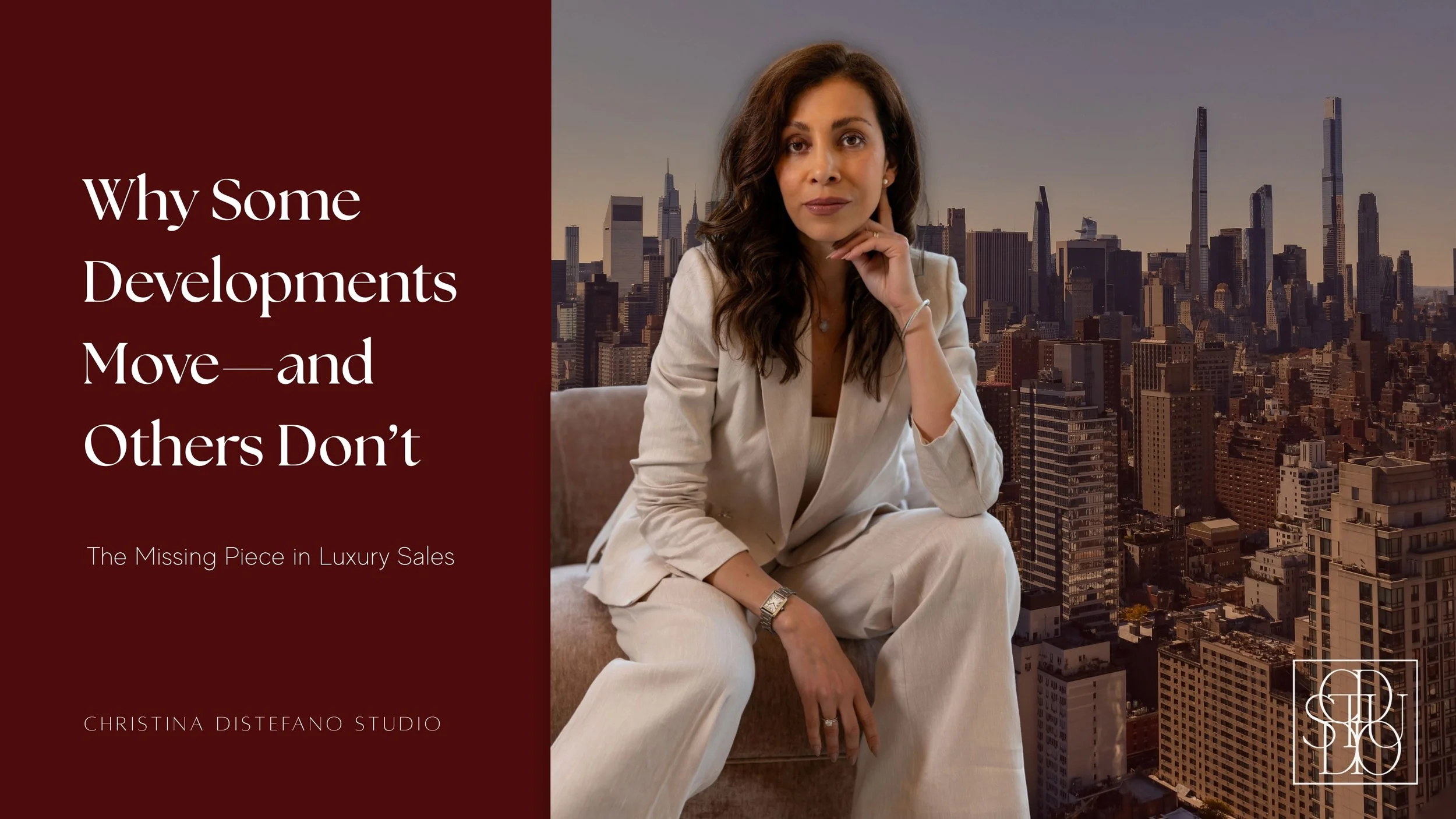
Developers, let me tell you something you may not be expecting to hear.
You are not selling square footage—no matter how often the industry pretends that you are.
You are selling identity.
This is not a philosophical distinction. It is the difference between momentum and stagnation. The issue is not that developers think they are selling square footage. Of course they do. That is how projects are underwritten, priced, approved, and marketed. Square footage is how the industry organizes value.
But buyers do not experience value the way the industry measures it.
What matters is not what you believe you are selling. What matters is what your buyer is actually buying. And buyers are not buying square footage. They are buying identity alignment.
They are buying the version of themselves they believe will exist inside the space—the way they will live, feel, move, host, rest, and be perceived. They are buying safety, authority, privacy, arrival, reinvention, or legacy. Often all at once.
Once you understand this, the behavior of the market starts to make sense.
When a development stalls, it is rarely because the market is slow. It is because the identity being offered is unclear, diluted, or misaligned. And no amount of pricing strategy, incentive structuring, or marketing volume can correct that.
We are living in an era where it has become very convenient to blame the market. Interest rates. Global uncertainty. Election cycles. Buyer hesitation. Media narratives. These phrases circulate easily through boardrooms and sales meetings. They are offered to investors as explanations. They are whispered behind closed doors when velocity slows, absorption disappoints, or a project carries the quiet tension that something simply isn’t working. But the truth is far more precise—and far more uncomfortable to admit.
Most underperforming luxury developments do not have a market problem. They have a meaning problem. And meaning does not respond to strategy alone. It responds to identity.
The market is not a force acting against your building. It is a mirror, reflecting back the emotional clarity—or lack of clarity—behind it. When a building’s identity is clear, coherent, and deeply understood by the people bringing it into the world, buyers feel it immediately. They may not be able to articulate why, but their nervous system registers safety, alignment, and truth.
In those moments, the market becomes almost irrelevant.
People stretch beyond their original plans. They prioritize differently. They move faster than logic would suggest. They cross cities, countries, even continents to belong in a space that recognizes them.
When that identity is unclear, the opposite occurs.
Buyers hesitate without understanding why. They second-guess. They compare endlessly. They negotiate, delay, disappear. And the story becomes familiar: the market is slow. In reality, the market is responding exactly as it should—to emotional misalignment.
People do not buy apartments. They buy selves.
They buy the version of themselves they imagine will exist inside the space—the woman who wakes up to that light, the man who pours coffee in that kitchen, the family that gathers in that living room. They buy power, quiet, reinvention, safety, legacy.
This is not poetic framing. It is psychology.
Messaging that speaks only to finishes and specifications appeals to logic. Logic can evaluate a listing, but it rarely signs a contract. Identity does. And identity is constructed through meaning.
Many developers believe they have a marketing problem. They don’t. They have a templated luxury problem.
The industry has trained itself to repeat the same language for decades—unparalleled, exceptional, breathtaking, exclusive, an elevated lifestyle.
For buyers who already live extraordinary lives, this language has lost its signal.
They are not moved by scale. They are moved by truth. By specificity. By recognition. By resonance. Which requires something most campaigns never fully define: a clearly articulated identity for the building. Not an aesthetic. Not a mood. An identity.
When meaning is absent, price becomes the battleground. Buyers fixate on price per square foot, comparative inventory, leverage, incentives, timing. This is not about money. It is about emotional certainty.
Certainty creates attachment. Uncertainty creates protection.
Protection negotiates. Protection hesitates. Protection waits.
Buildings carry emotional states. Some feel grounded. Some feel guarded. Some feel confident. Some feel unresolved. Some feel unseen. These emotional states are shaped by intention, language, tone, energy, and the stories told—or avoided. Sophisticated buyers feel this instantly, often before they ever step inside.
This is why two buildings on the same block can perform entirely differently.
It is not logical. It is emotional.
For decades, financial ROI has been the dominant metric of success. But Emotional ROI™ has quietly become the driver of value. It is the return a buyer experiences in their nervous system, identity, and sense of arrival. When Emotional ROI™ is strong, decisions accelerate, negotiations soften, attachment deepens, and momentum sustains. When it is weak, even the most expensive properties feel cold, generic, or forgettable.
The most important question is not how do we sell this. It is who is this meant to serve.
A building should not try to attract everyone who can afford it. It should magnetize the person who belongs inside it. Until that meaning is fully claimed, the market will continue to feel slow. And the building will continue to wait.
It’s not the market.
It’s the meaning.
And once the meaning is clear, the right buyer doesn’t need to be convinced. They recognize themselves immediately—because they finally feel seen.
EXPLORE MORE EMOTIONAL ROI™ ARTICLES ON MY LINKEDIN HERE.